1. Overview
1. 概要
The KIT Speaking Test Corpus (KISTEC) has been developed by Katsunori Kanzawa at Kyoto Institute of Technology (KIT) in Japan and his team. It comprises transcribed and tagged speech responses to the KIT Speaking Test (Section 3), a computer-based semi-direct English speaking test administered to all first-year undergraduates at KIT.
The KIT Speaking Test Corpus(KISTEC)は、京都工芸繊維大学(KIT)の神澤克徳と研究チームが構築した学習者コーパスです。KITの学部1年次生全員を対象に実施されたコンピュータ方式の半直接型英語スピーキングテスト、KIT Speaking Test(3節)の解答音声を書き起こし、タグを付与したデータで構成されています。
What makes KISTEC distinctive is that speech, task, and assessment are integrated at the level of the individual response. Every response in the corpus is linked to:
KISTECの大きな特色は、発話・タスク・評価が解答単位で結びついている点にあります。コーパス内のすべての解答には、次の情報が対応づけられています。
- the full content of the task that elicited it, published on this website (Section 5.2);
- Task Achievement and Task Delivery scores assigned to that particular response by trained raters; and
- metadata on the speaker, including equated test scores, TOEIC L&R scores, and English learning experience.
- その解答を引き出したタスクの全内容(本サイトで公開。5.2節)
- 訓練を受けた評価者がその解答に付与したTask AchievementおよびTask Deliveryのスコア
- 等化スコア、TOEIC L&Rスコア、英語学習経験などの話者メタデータ
This linkage allows questions that are difficult to address with existing corpora—for example, how the same learner’s performance varies across tasks, or which features of a response are associated with higher scores.
この対応づけにより、既存のコーパスでは扱いにくかった問い、たとえば、同一学習者のパフォーマンスがタスクによってどう異なるか、解答のどのような特徴が高い評価と結びついているかを検討できます。
The KISTEC is available to everyone. To download the data, see Section 5; to use the Search Interface online, see Section 6. In either case, please review the terms and conditions in Section 9.
KISTECはどなたでもご利用いただけます。データのダウンロードについては5節を、オンラインの検索インターフェースについては6節をご覧ください。いずれの場合も、9節の利用規約をご確認ください。
This project has received approval from the KIT Research Ethics Review Board. Only speech responses from examinees who consented to participate in the project have been included in the corpus.
本プロジェクトは、京都工芸繊維大学「ヒトを対象とする研究倫理審査委員会」の承認を得ています。コーパスには、プロジェクトへの参加に同意した受験者の解答音声のみを収録しています。
2. Why KISTEC?
2. KISTECの特色
Spoken corpora of Japanese learners of English remain scarce. In addition, existing corpora rarely publish the tasks used to elicit the speech—often because they are built on commercial tests—and proficiency information is usually a single level per learner rather than a score for each response. Without the task, it is hard to tell whether an observed feature reflects the learner, the task, or both; without response-level scores, features of speech cannot be related to the evaluations the speech actually received.
日本語を母語とする英語学習者の話し言葉コーパスは、依然として数が限られています。さらに、既存のコーパスは商用テストにもとづくことが多いために、発話を引き出したタスクが十分に公開されておらず、習熟度の情報も解答ごとのスコアではなく学習者ごとの単一のレベルであるのが一般的です。タスクの情報が十分でなければ、観察された特徴が学習者によるものか、タスクによるものか、その両方によるものかを判断することは困難です。また、解答単位のスコアがなければ、発話の特徴を、その発話が実際に受けた評価と関連づけることができません。
KISTEC was designed to fill these gaps. Its four design principles are:
KISTECは、こうした課題を埋めることを目指して設計されました。設計方針は次の4点です。
- speech from an entire cohort of first-year university students, not from self-selected volunteers;
- nine task types, all publicly available;
- human ratings attached to every single response; and
- integrated metadata, from learner attributes to external proficiency scores.
- 志願者ではなく、大学1年次生の全員から収集した発話データであること
- 9種類のタスクをすべて公開していること
- すべての解答に人手による評価が付与されていること
- 学習者属性から外部の習熟度指標まで、メタデータが統合されていること
3. The KIT Speaking Test
3. KIT Speaking Test
3.1 A local test
3.1 ローカルテストとしての特性
The KIT Speaking Test is a local test, developed by faculty members at KIT and used within the university. Because the test is locally owned, its tasks, rating scales, and response data can be shared with the research community—something commercial testing programs rarely permit.
KIT Speaking Testは、京都工芸繊維大学の教員が開発し、学内で運用しているローカルテストです。テストを自機関で保有しているため、タスク、評価基準、解答データを研究コミュニティと共有できます。これは商用のテストではほとんど認められていません。
3.2 Examinees
3.2 受験者
The test was administered to all first-year undergraduates across the university’s six degree programs. Because the entire cohort took the test, the data reflect average students rather than volunteers, who tend to be more motivated or proficient than their peers.
テストは、京都工芸繊維大学の6つの課程すべての学部1年次生全員を対象に実施されました。学年全体が受験しているため、データは、志願者ではなく、平均的な学生の姿を反映しています。
Approximately 97% of the examinees were Japanese, and the remaining 3% were international students from Asian countries, including China, Malaysia, and South Korea; a nationality header allows analyses to be restricted to Japanese nationals. The examinees’ mean TOEIC L&R score was 563.54 (SD: 133.15, range: 195–985), corresponding to roughly B1 on the CEFR. Since Japanese learners’ speaking typically lags behind their listening and reading, their speaking proficiency is estimated to center on A2.
受験者の約97%は日本国籍で、残りの約3%は中国、マレーシア、韓国などアジア圏からの留学生です。国籍のヘッダー情報が付与されているため、日本国籍の学習者のみに限定した分析も可能です。受験者のTOEIC L&Rスコアの平均は563.54(SD=133.15、範囲195–985)で、CEFRではおおよそB1程度に相当します。ただし、日本語を母語とする学習者はスピーキングがリスニング・リーディングより低くなる傾向があるため、スピーキング能力はA2程度が中心と推察されます。
3.3 Test format and tasks
3.3 テストの形式とタスク
The KIT Speaking Test is a computer-based, semi-direct speaking test: questions are presented using audio and a PC display, and responses are recorded through a headset microphone. Each examinee took one of three parallel versions (Ver. 1–3) and responded to nine questions in three parts:
KIT Speaking Testは、コンピュータ方式の半直接型スピーキングテストです。設問は音声とPCの画面で提示され、解答はヘッドセットのマイクで録音されます。各受験者は3つの並行バージョン(Ver. 1–3)のいずれかを受験し、3つのパートで計9問に解答します。
- Part 1: Examinees respond based on the pictures presented (no planning time).
- Part 2: Examinees listen to a conversation, then summarize it and express their own opinions about it (no planning time).
- Part 3: Examinees organize their thoughts and opinions and discuss them logically (with one-minute planning time).
- Part 1:提示された写真をもとに解答する(準備時間なし)
- Part 2:会話を聞いた上で、その内容を要約し、自分の意見を述べる(準備時間なし)
- Part 3:自分の考えや意見を整理し、論理的に述べる(1分間の準備時間あり)
The following table lists the test items for Ver. 1 to Ver. 3. The full version of the items can be downloaded in Section 5.2.
Ver. 1からVer. 3までのタスク一覧を下表に示します。写真や会話スクリプトを含む詳細版は5.2節からダウンロードできます。
| Question NO. | Task type | Rehearsal time(sec.) | Response time(sec.) | Ver. 1 | Ver. 2 | Ver. 3 | |
|---|---|---|---|---|---|---|---|
| Part 1 | Q1 | Imagine | 0 | 45 | Imagine why the bicycle is left here. | Imagine why the cup is left here. | Imagine why the bags are left here. |
| Q2 | Imagine | 0 | 45 | Imagine what the man is thinking. | Imagine what the man is thinking. | Imagine what the boy is thinking. | |
| Q3 | Compare | 0 | 45 | Which of these things would you buy for a 5-year-old child to play with, building blocks or a computer? Explain the reasons for your choice, comparing the advantages and disadvantages of both. | Which of these places would you prefer to live in, a large house or a high-rise apartment? Explain the reasons for your choice, comparing the advantages and disadvantages of both. | Where would you take your guests from abroad, to the countryside or to a big city? Explain the reasons for your choice, comparing the advantages and disadvantages of both. | |
| Part 2 | Q4 | Identify different values | 0 | 45 | How are Bill’s and Kyoko’s opinions different? | How are Bill’s and Mariam’s opinions different? | How are Kenji’s and Susan’s opinions different? |
| Q5 | Take position | 0 | 60 | Which way of thinking do you support? Explain your position and give reasons. | Which way of thinking do you support? Explain your position and give reasons. | Which way of thinking do you support? Explain your position and give reasons. | |
| Q6 | Identify problem | 0 | 45 | What is the problem Kate is facing? | What is the problem Susan is facing? | What is the problem Mariam is facing? | |
| Q7 | Problem solving | 0 | 60 | If you were Kate, what would you do to solve the problem? | If you were Susan, what would you do to solve the problem? | If you were Mariam, what would you do to solve the problem? | |
| Part 3 | Q8 | Plan and organise | 60 | 60 | You have been asked to make a promotional video of your university. Explain how you would organize it. | You want to establish a new cycling club in your university. Explain how you would organize it. | You want to organize a party for your high school classmates. Explain how you would organize it. |
| Q9 | Persuade | 60 | 60 | You are talking with friends from other countries about holidays. Explain to them why they should visit your country. | Some friends from another country are visiting you for one week. Choose a place for them to go and explain why they should go there. | You are talking with friends about hobbies. Explain to them why your hobby is interesting and why they should try it. |
| Part | Question No. | Task Type | Rehearsal Time(秒) | Response Time(秒) | Ver. 1 | Ver. 2 | Ver. 3 |
|---|---|---|---|---|---|---|---|
| Part 1 | Q1 | Imagine | 0 | 45 | Imagine why the bicycle is left here. | Imagine why the cup is left here. | Imagine why the bags are left here. |
| Q2 | Imagine | 0 | 45 | Imagine what the man is thinking. | Imagine what the man is thinking. | Imagine what the boy is thinking. | |
| Q3 | Compare | 0 | 45 | Which of these things would you buy for a 5-year-old child to play with, building blocks or a computer? Explain the reasons for your choice, comparing the advantages and disadvantages of both. | Which of these places would you prefer to live in, a large house or a high-rise apartment? Explain the reasons for your choice, comparing the advantages and disadvantages of both. | Where would you take your guests from abroad, to the countryside or to a big city? Explain the reasons for your choice, comparing the advantages and disadvantages of both. | |
| Part 2 | Q4 | Identify different values | 0 | 45 | How are Bill’s and Kyoko’s opinions different? | How are Bill’s and Mariam’s opinions different? | How are Kenji’s and Susan’s opinions different? |
| Q5 | Take position | 0 | 60 | Which way of thinking do you support? Explain your position and give reasons. | Which way of thinking do you support? Explain your position and give reasons. | Which way of thinking do you support? Explain your position and give reasons. | |
| Q6 | Identify problem | 0 | 45 | What is the problem Kate is facing? | What is the problem Susan is facing? | What is the problem Mariam is facing? | |
| Q7 | Problem solving | 0 | 60 | If you were Kate, what would you do to solve the problem? | If you were Susan, what would you do to solve the problem? | If you were Mariam, what would you do to solve the problem? | |
| Part 3 | Q8 | Plan and organise | 60 | 60 | You have been asked to make a promotional video of your university. Explain how you would organize it. | You want to establish a new cycling club in your university. Explain how you would organize it. | You want to organize a party for your high school classmates. Explain how you would organize it. |
| Q9 | Persuade | 60 | 60 | You are talking with friends from other countries about holidays. Explain to them why they should visit your country. | Some friends from another country are visiting you for one week. Choose a place for them to go and explain why they should go there. | You are talking with friends about hobbies. Explain to them why your hobby is interesting and why they should try it. |
3.4 Rating
3.4 評価
Each question was rated by a pair of trained raters, one native and one non-native speaker of English, with different pairs assigned to different questions (18 raters in total). Responses were rated on two scales from 0 to 5: Task Achievement (TA), which evaluates how well the response accomplished the task, and Task Delivery (TD), which evaluates how effectively the response was delivered. When the two ratings differed by 2 points or more, an experienced senior rater reassessed the response; otherwise, the two scores were averaged. Raw scores therefore run from 0 to 5 in increments of 0.5.
各設問は、訓練を受けた英語母語話者1名と非母語話者1名のペアが評価しました。評価者は設問ごとに異なり、全体では計18名が担当しています。評価は、タスクをどの程度達成できたかをみるTask Achievement(TA)と、自らの発話をどの程度効果的に伝えられたかをみるTask Delivery(TD)の2観点について、それぞれ0–5の6段階で行われました。2名の評定に2点以上の差があった場合は、評価に熟達したシニアレイターが再評価し、それ以外は2名のスコアの平均値を採用しています。したがって素点は0から5まで0.5刻みとなります。
| Score | Task Achievement (80% weighting) | Task Delivery (20% weighting) |
|---|---|---|
| 5 | The task is achieved, being developed with a satisfactory level of detail. | The delivery is mostly confident. Given time is well used without obvious problems with delivery such as intrusive pauses, hesitations, or repetitions. |
| 4 | The task is mostly achieved, with some supporting detail in places. | Given time is quite well used despite some problems with delivery such as slow rate of speech, pauses, hesitations, or repetitions. |
| 3 | The task is minimally or partially achieved, being supported with some basic detail. | General meaning comes across, but given time is not effectively used because of problems with delivery such as slow rate of speech, pauses, hesitations, or repetitions. |
| 2 | The task is addressed, but there is no or very little supporting detail. | The speaker keeps trying, but problems with delivery such as slow rate of speech, pauses, hesitations, or repetitions allow a very limited amount of meaning to be conveyed. |
| 1 | The task remains essentially unachieved, though there may be some relevant words. | The speaker gives up trying, or problems with delivery such as slow rate of speech, pauses, hesitations, or repetitions are fatal to meaning coming across. |
| 0 | There is no relevant contribution. For example, the content is entirely unconnected to the topic. | The speaker does not start the task. For example, the speaker is silent, utters only fillers, or just says “I don’t know.” |
| Score | Task Achievement(TA、80%) | Task Delivery(TD、20%) |
|---|---|---|
| 5 | The task is achieved, being developed with a satisfactory level of detail. | The delivery is mostly confident. Given time is well used without obvious problems with delivery such as intrusive pauses, hesitations, or repetitions. |
| 4 | The task is mostly achieved, with some supporting detail in places. | Given time is quite well used despite some problems with delivery such as slow rate of speech, pauses, hesitations, or repetitions. |
| 3 | The task is minimally or partially achieved, being supported with some basic detail. | General meaning comes across, but given time is not effectively used because of problems with delivery such as slow rate of speech, pauses, hesitations, or repetitions. |
| 2 | The task is addressed, but there is no or very little supporting detail. | The speaker keeps trying, but problems with delivery such as slow rate of speech, pauses, hesitations, or repetitions allow a very limited amount of meaning to be conveyed. |
| 1 | The task remains essentially unachieved, though there may be some relevant words. | The speaker gives up trying, or problems with delivery such as slow rate of speech, pauses, hesitations, or repetitions are fatal to meaning coming across. |
| 0 | There is no relevant contribution. For example, the content is entirely unconnected to the topic. | The speaker does not start the task. For example, the speaker is silent, utters only fillers, or just says “I don’t know.” |
After rating, examinee proficiency was estimated using Item Response Theory (IRT), yielding three equated scores that are comparable across test versions: Overall score (0–100), TA rank (1–5), and TD rank (1–5). Since the test places a strong emphasis on task achievement, the Overall score weights TA at 80% and TD at 20%. The equated scores are distributed as follows:
評価後、項目反応理論(IRT)を用いて受験者の能力値を推定し、テストバージョン間で比較可能な3種類の等化スコア、すなわちOverall score(0–100)、TA rank(1–5)、TD rank(1–5)を算出しました。本テストはタスク達成度を重視するため、Overall scoreはTAを80%、TDを20%として重み付けされています。等化スコアの分布は次のとおりです。
| Score type | Average (Standard deviation) | Max | Min |
|---|---|---|---|
| Overall score | 48.22 (10.45) | 90 | 21 |
| TA rank | 2.97 (1.42) | 5 | 1 |
| TD rank | 2.98 (1.40) | 5 | 1 |
| スコア種別 | 平均 | 標準偏差 | 最高 | 最低 |
|---|---|---|---|---|
| Overall score | 48.22 | 10.45 | 90 | 21 |
| TA rank | 2.97 | 1.42 | 5 | 1 |
| TD rank | 2.98 | 1.40 | 5 | 1 |
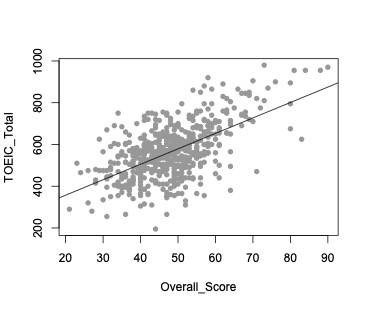
The figure below plots the KIT Speaking Test scores on the horizontal axis and TOEIC L&R scores on the vertical axis. The correlation coefficient between the two is 0.59.
下図は、KIT Speaking Testのスコア(横軸)とTOEIC L&Rスコア(縦軸)の関係を示したものです。両者の相関係数は0.59です。
4. The corpus
4. KISTEC
4.1 Corpus size
4.1 コーパスの規模
The corpus comprises transcribed responses from 574 examinees (191 for Ver. 1, 191 for Ver. 2, and 192 for Ver. 3), each of whom was allocated 7 minutes and 45 seconds of response time across the nine tasks. In total, the corpus contains approximately 290,000 words and 74 hours of speech.
本コーパスは、574名の受験者(Ver. 1:191名、Ver. 2:191名、Ver. 3:192名)の解答を書き起こしたものです。各受験者には9つのタスク全体で7分45秒の解答時間が与えられています。コーパス全体では、約29万語、約74時間の発話を収録しています。
4.2 Corpus files
4.2 コーパスファイル
The corpus is distributed in plain-text (.txt) format in two versions: a tagged version, which contains header information (metadata) and speech tags, and an untagged version, which contains plain transcriptions only.
本コーパスはプレーンテキスト(.txt)形式で2つのバージョン、すなわちヘッダー情報(メタデータ)と発話タグを含むタグ付きバージョンと、書き起こしテキストのみのタグなしバージョンを配布しています。
The file format and the transcription and tagging conventions follow those of the NICT JLE Corpus as closely as possible. Tools and scripts developed for that corpus can therefore be reused with KISTEC, and results can be compared across the two corpora. Detailed guidelines are provided in the transcription/tagging manual (Section 5.3).
ファイル形式および書き起こし・タグ付けの方法は、可能な限りNICT JLE Corpusに準拠しています。そのため、同コーパス向けに開発されたツールやスクリプトをKISTECでも再利用でき、両コーパス間で結果を比較することもできます。詳細は『書き起こし・タグ付与ガイドライン』(5.3節)をご覧ください。
4.2.1 Header information
4.2.1 ヘッダー情報
| Header information | Meaning |
|---|---|
| <grade> | Year of study |
| <nationality> | Nationality |
| <sex> | Sex (1 = male, 2 = female) |
| <version> | Version of the speaking test taken (1–3) |
| <total_score> | Equated overall score on the speaking test (0–100) |
| <ta_rank> | Equated TA rank (1–5) |
| <td_rank> | Equated TD rank (1–5) |
| <ta1-9_score> | Raw TA score of the response to each of the nine tasks (0–5); not equated |
| <td1-9_score> | Raw TD score of the response to each of the nine tasks (0–5); not equated |
| <toeic_score> | TOEIC L&R total score (10–990) |
| <toeic_rscore> | TOEIC Reading score (5–495) |
| <toeic_lscore> | TOEIC Listening score (5–495) |
| <experience1> | The following are the responses to the survey by IIBC (a TOEIC developer in Japan). How many years have you studied English? A=4 years or fewer/B=4–6 years/C=6–10 years/D=10 years or more/Blank=No answer |
| <experience2> | Which of the following language skill(s) is/are the most important for you? A=Listening/B=Reading/C=Speaking/D=Writing/E= Listening and Speaking/F= Reading and Writing /G=All of them/Blank=No answer |
| <experience3> | What percentage do you use English in your daily life? A=0%/B=1–10%/C=11–20%/D=21–50%/E=51–100%/Blank=No answer |
| <experience4> | Which of the following language skills do you use the most? A=Listening/B=Reading/C=Speaking/D=Writing/E= Listening and Speaking/F= Reading and Writing/G=All of them/Blank=No answer |
| <experience5> | How often does your lack of English proficiency prevent your communication? A=hardly ever/B=occasionally/C=sometimes/D=often/E=usually/ Blank=No answer |
| <experience6> | Have you ever stayed in a country where English is the primary language? A=No/B=6 months or fewer/C=6–12 months /D=1–2 years/E=1 or more years/Blank=No answer |
| <experience7> | What was the purpose of your stay in a country where English is the primary language? A=Study (excluding learning English)/B=To participate in an English language learning program/C=Travel (excluding business)/D=Business/E=Others/Blank=No answer |
| ヘッダー情報 | 概要 |
|---|---|
| <grade> | 大学の学年 |
| <nationality> | 国籍 |
| <sex> | 性別(1=男性、2=女性) |
| <version> | 受験したテストバージョン(1–3) |
| <total_score> | KIT Speaking Testの等化トータルスコア(0–100) |
| <ta_rank> | 等化されたTA rank(1–5) |
| <td_rank> | 等化されたTD rank(1–5) |
| <ta1-9_score> | 各問の解答に対するTA素点(0–5、等化前) |
| <td1-9_score> | 各問の解答に対するTD素点(0–5、等化前) |
| <toeic_score> | TOEIC L&Rのトータルスコア(10–990) |
| <toeic_rscore> | TOEIC L&Rのリーディングスコア(5–495) |
| <toeic_lscore> | TOEIC L&Rのリスニングスコア(5–495) |
| <experience1> | 以下はIIBC(TOEIC運営団体)による調査への回答である。 何年間、英語を学習していますか。 A=4年以下/B=4–6年/C=6–10年/D=10年以上/空欄=無回答 |
| <experience2> | 次のうち、最も重要視する/していた英語の技能はどれですか。 A=リスニング/B=リーディング/C=スピーキング/D=ライティング/E=リスニングとスピーキング/F=リーディングとライティング/G=すべて/空欄=無回答 |
| <experience3> | 日常生活において英語を使用する割合はどのくらいですか。 A=0%/B=1–10%/C=11–20%/D=21–50%/E=51–100%/空欄=無回答 |
| <experience4> | 次の英語技能のうち、最もよく使用するものはどれですか。 A=リスニング/B=リーディング/C=スピーキング/D=ライティング/E=リスニングとスピーキング/F=リーディングとライティング/G=すべて/空欄=無回答 |
| <experience5> | 英語のやりとりに苦労する頻度はどのくらいですか。 A=ほとんどない/B=まれにある/C=ときどきある/D=しばしばある/E=いつもある/空欄=無回答 |
| <experience6> | 英語を主言語とする国に滞在したことがありますか。 A=なし/B=6か月以下/C=6–12か月/D=1–2年/E=1年以上/空欄=無回答 |
| <experience7> | 英語圏に滞在した主な目的は何でしたか。 A=留学(英語学習を除く)/B=英語学習プログラムへの参加/C=旅行(業務を除く)/D=業務/E=その他/空欄=無回答 |
4.2.2 Speech tags
4.2.2 発話タグ
| Tags | Meaning |
|---|---|
| <F> </F> | Filler |
| <R> </R> | Repetition |
| <R?> </R?> | Repetition (transcriber not confident in listening) |
| <SC> </SC> | Self-correction |
| <SC?> </SC?> | Self-correction (transcriber not confident in listening) |
| <TO> </TO> | Timeout (speech cut off by the response time limit) |
| <RE> </RE> | Recording error |
| <nvs> </nvs> | Nonverbal sound (laughter, sigh, cough, yawn) |
| <CO> </CO> | Cutoff (speech suspended by the speaker) |
| <?> </?> | Not confident in listening |
| <??> </??> | Completely unintelligible |
| <H pn=“X”> </H> | Proper nouns, discriminatory terms, and others (content removed) |
| <JP> </JP> | Japanese |
| <.> </.> | Pause (2–3 s) |
| <..> </..> | Pause (3 s or more) |
| <laughter> </laughter> | Laughing while speaking |
| タグ | 用途 |
|---|---|
| <F> </F> | フィラー |
| <R> </R> | 繰り返し(聞き取りに自信がある) |
| <R?> </R?> | 繰り返し(聞き取りに自信がない) |
| <SC> </SC> | 自己訂正(聞き取りに自信がある) |
| <SC?> </SC?> | 自己訂正(聞き取りに自信がない) |
| <TO> </TO> | タイムアウト |
| <RE> </RE> | レコーディングエラー |
| <nvs> </nvs> | 非言語音 |
| <CO> </CO> | 途中で中断した発話 |
| <?> </?> | 聞き取りに自信がない箇所 |
| <??> </??> | 全く聞き取り不可能な箇所 |
| <H pn=“X”> </H> | 固有名詞・差別用語など |
| <JP> </JP> | 日本語 |
| <.> </.> | 2秒–3秒のポーズ |
| <..> </..> | 3秒以上のポーズ |
| <laughter> </laughter> | 笑いながらの発話 |
4.3 Notes on using the data
4.3 データ利用上の注意
- The speech was produced under test conditions: time-limited monologues addressed to a computer. Features such as pauses and fillers may pattern differently in dialogue or everyday conversation.
- The examinees are a single cohort at one university, with speaking proficiency centered on CEFR A2. On its own, the corpus is not suited to studying highly proficient speakers, and findings should not be generalized to all Japanese learners of English.
- 収録された発話は、テストという条件下(コンピュータに向かっての発話、時間制限のあるモノローグ)で産出されたものです。ポーズやフィラーなどの特徴は、対話や日常会話では異なる現れ方をする可能性があります。
- 受験者は1つの大学の1学年のみで、スピーキング能力はCEFR A2程度が中心です。そのため本コーパス単独では習熟度の高い話者の研究には適しておらず、知見を日本語を母語とする英語学習者全体に一般化することはできません。
5. Downloads
5. ダウンロード
5.1 Corpus files
5.1 コーパスファイル
Both the tagged and untagged versions of the corpus are available for download in zip format, secured with a password. To obtain the password, please fill out the registration form; the password will be sent to the registered email address.
タグ付き・タグなしの両バージョンを、パスワード付きのzip形式でダウンロードできます。パスワードは登録フォームにご記入いただくと、登録されたメールアドレス宛に送付されます。
Notes:
注意事項
- The file ‘316’ has been removed from the corpus due to silence (recording error).
- The untagged version excludes header information; please refer to the tagged version for this data.
- ファイル「316」は無音(レコーディングエラー)のため、コーパスから除外しています。
- タグなしバージョンにはヘッダー情報が含まれていません。ヘッダー情報はタグ付きバージョンをご参照ください。
5.2 Test tasks
5.2 テストタスク
The complete version of the test tasks (paper format) can be downloaded below.
テストタスクの詳細版(紙媒体)を以下からダウンロードできます。
Note: In Part 2 of the actual test, the conversation scripts are not presented to the examinees; they only listen to the audio of the conversation.
注:実際のテストのPart 2では、会話スクリプトは受験者に提示されず、受験者は会話音声を聞くのみです。
5.3 Transcription/tagging manual
5.3 書き起こし・タグ付与ガイドライン
The transcription/tagging manual can be downloaded below.
『書き起こし・タグ付与ガイドライン』を以下からダウンロードできます。
6. Search Interface
6. KISTEC Search Interface
The Search Interface for the KISTEC, developed and owned primarily by Yusuke Tanaka at Kumamoto Gakuen University, allows the corpus to be searched online without downloading:
熊本学園大学の田中悠介氏が中心となって開発・運用しているKISTEC Search Interfaceを使うと、データをダウンロードすることなくオンラインでコーパスを検索できます。
It supports KWIC search, collocation analysis, wordlist generation, characteristic-word extraction, and N-gram analysis; results can be filtered by task, gender, and test scores, and exported as CSV files.
KWIC検索、コロケーション分析、ワードリスト作成、特徴語抽出、Nグラム分析に対応しています。検索結果はタスク、性別、テストスコアで絞り込むことができ、CSVファイルとして書き出すこともできます。
Reports of bugs, comments on usability, and feature requests are all welcome: please contact Yusuke Tanaka at yusuke.tanaka.07[at mark]gmail.com.
不具合のご報告、使い勝手についてのご意見、機能のご要望を歓迎します。田中悠介氏(yusuke.tanaka.07[at mark]gmail.com)までお寄せください。
7. Our team
7. メンバー
Researchers
研究者
- Katsunori Kanzawa (Kyoto Institute of Technology)
- Yuichiro Kobayashi (Nihon University)
- Jaeho Lee (Waseda University)
- Haruhiko Mitsunaga (Nagoya University)
- Masayuki Mori (Kyoto Institute of Technology)
- Yusuke Tanaka (Kumamoto Gakuen University)
- Taishi Chika (University of Toyama)
Transcribers (Graduate students)
書き起こし作業者(大学院生)
- Taishi Chika (Kyoto University), 2019–2020
- Mitsuyuki Kato (Kyoto Prefectural University), 2019
- Takumi Kitahara (Kyoto University), 2019–2020
- Toshifumi Taniwaki (Ritsumeikan University), 2019
- Taku Motozawa (Kyoto University), 2020
- 近大志(京都大学大学院)2019–2020
- 加藤満幸(京都府立大学大学院)2019
- 北原匠(京都大学大学院)2019–2020
- 谷脇聡史(立命館大学大学院)2019
- 本澤拓(京都大学大学院)2020
Note: Affiliations are as of the time of the work.
注:所属は作業当時のものです。
8. Grants
8. 研究助成
This project has received support from the following grants:
本プロジェクトは、以下の助成を受けています。
- JSPS KAKENHI 19K00849 “Corpus development based on speech responses by Japanese university students to the computer-based English speaking test” (AY 2019–2021)
- JSPS KAKENHI 22K00736 “Exploring Task Achievement for improving scoring efficiency in English speaking tests” (AY 2022–2026)
- JSPS科研費 19K00849「日本の大学生によるCBT英語スピーキングテスト回答音声データに基づくコーパス構築」(2019–2021年度)
- JSPS科研費 22K00736「英語スピーキングテストの採点効率化に向けたTask Achievementの解明」(2022–2026年度)
9. Terms and conditions
9. 利用規約
By downloading the KISTEC or using the Search Interface for the KISTEC, you agree to the following terms and conditions. Any violations will result in a warning. If you do not comply with this warning in a timely manner, legal action may be taken. Please be aware that these terms and conditions may be updated without prior notice, and the most recent version will apply.
KISTECをダウンロードする、またはKISTEC Search Interfaceを利用することにより、以下の利用規約に同意したものとみなされます。規約に違反した場合は警告を行います。警告に速やかに応じていただけない場合、法的措置をとることがあります。なお、本規約は予告なく更新されることがあり、常に最新版が適用されます。
- Below is an example of how to reference the KISTEC in APA 7th edition style. When you download and use the KISTEC, please include (1) in your reference list. When you use the Search Interface for the KISTEC, please include both (1) and (2) in your reference list.
- (1) Kanzawa, K., Kobayashi, Y., Lee, J., Mitsunaga, H., Mori, M., Tanaka, Y., & Chika, T. (n.d.). The KIT Speaking Test Corpus (KISTEC). https://kitstcorpus.jp
- (2) Tanaka, Y., Setoguchi, A., Chika, T., & Kanzawa, K. (n.d.). Search Interface for the KIT Speaking Test Corpus. https://www.kistecsearch.org/
- Use the corpus at your own risk. The KISTEC team is not liable for any damage, loss, or other disadvantages that may arise from its use.
- In principle, original speech responses to the KIT Speaking Test are included in this corpus without alteration. The KISTEC team is not responsible for the content of these utterances, which may contain inappropriate material.
- Despite the KISTEC team’s best efforts to build the corpus, it may still contain errors, for which the team assumes no responsibility. If you encounter any errors, please contact the project leader, Katsunori Kanzawa, at kanzawa[at mark]kit.ac.jp.
- The corpus and website may be updated or removed without notice.
- You are allowed to modify and redistribute the corpus; however, please indicate which parts have been altered.
- 以下はKISTECをAPA第7版の形式で引用する例です。KISTECをダウンロードして利用する場合は(1)を、KISTEC検索インターフェースを利用する場合は(1)と(2)の両方を参考文献リストに記載してください。
- (1) Kanzawa, K., Kobayashi, Y., Lee, J., Mitsunaga, H., Mori, M., Tanaka, Y., & Chika, T. (n.d.). The KIT Speaking Test Corpus (KISTEC). https://kitstcorpus.jp
- (2) Tanaka, Y., Setoguchi, A., Chika, T., & Kanzawa, K. (n.d.). Search Interface for the KIT Speaking Test Corpus. https://www.kistecsearch.org/
- KISTECの利用は自己責任でお願いします。利用によって生じたいかなる損害・損失・不利益についても、KISTECチームは責任を負いません。
- KISTECには、原則としてKIT Speaking Testの解答音声をそのまま収録しています。発話の内容には不適切な表現が含まれる可能性がありますが、その内容についてKISTECチームは責任を負いません。
- KISTECチームは細心の注意を払ってコーパスを構築していますが、誤りが含まれる可能性があり、それについて責任を負いかねます。誤りを見つけられた場合は、プロジェクト代表者の神澤克徳(kanzawa[at mark]kit.ac.jp)までご連絡ください。
- KISTECおよび本ウェブサイトは、予告なく更新または削除されることがあります。
- KISTECの改変および再配布は可能ですが、改変した箇所を明示してください。
10. Acknowledgments
10. 謝辞
We would like to express our gratitude to everyone at Kyoto Institute of Technology who was involved in the development and implementation of the KIT Speaking Test, including English faculty members, faculty and staff members of the Center for ICT Services, and all others who contributed to this project.
KIT Speaking Testの開発・実施に携わってくださった京都工芸繊維大学のすべての方々(英語科目担当教員、情報科学センター(現情報基盤センター)の教職員)、その他本プロジェクトにご協力くださったすべての方々に厚く御礼申し上げます。